skip to main |
skip to sidebar
I started the project sometime in mid-March last year and completed it sometime in mid-July, and having been listening to the resulting tracks on my laptop since then, I thought it was high time that I wrote up what I learned about the process. So here it is:
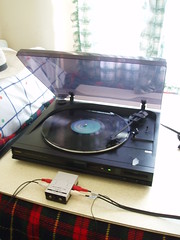
Hardware: I used my old Goodmans turntable (pictured above) hooked up to my old PC via a preamplifier unit. This set up seemed to work pretty well, although afterwards I wished that I had 1) invested in a new needle for the turntable, and 2) found a way to earth the turntable (to reduce the background hum on the recordings).
Software: my PC was running under Windows XP and I used Audacity (version 1.3.7) to capture and process the audio from the turntable arrangement:

As the PC is quite old I learned that it's sensible to close down all other programs and background processes (including screensavers) during the actual recordings - if the load on the system got too high then the resulting recordings sometimes ended up with skips that weren't on the original record.
Recording process: the procedure that I developed for each record was something like this:
- Fix the recording level in Audacity: the idea is to set the input volume level as high as possible whilst avoiding "clipping" of the recorded waveform. I'd do this by trial and error, by making test recordings from parts of the record that I thought were likely to be the loudest. Once I found the optimum level I made a note of it, in case I needed to re-record later on if I discovered a problem during playback.
- Clean the needle and the record: to reduce surface noise and the likelihood of pops, crackles and skips.
- Record each side of the disc in a single take: while the record was playing I would listen for "defects" such as pops/crackles, skips, drop-outs, making a note of the timecode for each as I heard it. (A comfortable pair of headphones is recommended if you're doing more than a few recordings.)
Post-processing: once I'd recorded one side, I'd save it as a single Audacity project and then do some post-processing of the recording to deal with the sound defects. I found this quite time consuming as I got a bit obsessive over cleaning up the recordings. The strategies that I used included:- Click removal tool: Audacity's Click removal tool (under the Effects menu) sometimes worked for me when trying to remove pops and crackles, but I found it a bit hit-and-miss to be honest.
- De-amplification: essentially highlighting the waveform around a pop and then applying amplification to e.g. -8db, using the Amplify tool (also under the Effects menu).
- Copy-and-paste: very fiddly technique but could be quite effective, using the options under the Edit menu I would copy a bit of the waveform from elsewhere in the track and then use this to replace the part with the defect.
De-amplification and copy-and-paste techniques generally worked okay for crackles and pops that were very short. On a couple of occasions where the recording had skipped I was also able to copy-and-paste longer sections to repair it, although it could be difficult to match the inserted section up with the original track.Once the defects had been dealt with I applied RIAA equalisation (under the Effects menu) to the whole track. At this point I sometimes also applied amplification to the whole thing, if it turned out that I'd chosen a recording level that was a bit too quiet.Check the recording & split into tracks: the final part of the ripping process was to check each recording by playing it back through Audacity (to ensure that it was complete and that there weren't any unexpected skips which might necessitate a re-recording), and then to break it up into individual tracks. To do this I added "labels" to the project to mark the start of each track, and then used the Export multiple option to automatically save them as WAV files.(An aside: WAV files are uncompressed so they are big! But because it's "loss-less", I reasoned that this would be a good "archival" format if I wanted to play around some more with a track later on. I've since wondered about converting them to FLAC, which would save disk space whilst preserving the data.)Import into iTunes: since I use iTunes to manage my music for "everyday use", I used it to generate compressed AAC-format versions for each track as it was added to the iTunes library:- In Edit Preferences->Advanced tab, deselect "Copy files to iTunes Music when adding to library".
- Select the files to add to the library using File->Add Folder option (n.b. drag and drop also works).
- Once the WAV files have been added, right-click on the first imported track in iTunes, select Update info and add data about the artist, album name, number of tracks and so on. (Note that it's also possible to select multiple tracks and add data for several at once.)
- Select the imported tracks, right-click on them and select Create AAC version from the menu. (The resulting AAC tracks will contain the artist and album data added in the previous step.)
- At the end, the library will contain two versions of each track - the original WAV file and the AAC version - so I went through and deleted the WAV versions from iTunes (note that this doesn't delete the original files, just the references to them).
Hopefully this all makes sense. It can be a long process and there are probably better ways of doing things, however this worked for me. If I did it again I'd seriously consider investing in a dedicated USB turntable, but for now in spite of the tedium of the process I'm happy to be able to listen to my old tunes on my ipod shuffle.
Anyways: I love swimming, but ordinarily I find that watching things like Olympic swimming on the telly is just about the most boring thing ever. With competitive swimming it's almost as if the participants are in a rush to finish and get out of the water - whereas I sometimes think I'd like to stay in the water and swim around all day.
So it was interesting to see a few shows at the end of last year which seemed more relevant to my experiences as a recreational swimmer. The first was back at the end of November, with the BBC documentary "Virgin Swimmers" (part of the "Wonderland" series). This followed a disparate group of adults as they took a course of weekly swimming lessons together, and reminded me a little of similar classes that I took a few years ago. The people in the programme were just regular folk, but what was fascinating was how learning swim often seemed emblematic of a deeper need to take on a challenge and prove something to themselves. Somehow it's not just about learning to swim.
I suppose that people do all sorts of things - like, I don't know, rock climbing or hang-gliding - to challenge themselves in a similar fashion, and perhaps the "challenge" of swimming in a pool at a local community centre seems quite mundane. But what this programme brought out was that for the people that do it, it can be just as much of a challenge - and an achievement - as climbing a mountain.
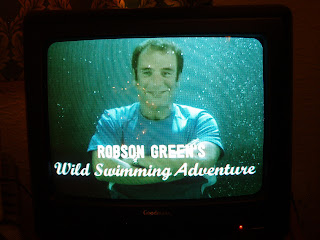
The second programme was the two-parter "Robson Green's Wild Swimming Adventure", shown on ITV in December (certainly an odd time of year for a show about the joys of swimming outdoors). When I first heard about this, I'll admit I was a little sceptical and wondered if it was just an attempt to capitalise on the resurgence of interest in outdoor swimming here in the UK.
In the event, in spite of some contrived sequences (I'm wasn't entirely convinced by either the opening scene - when he's rescued from his swim in the freezing waters of the river Tyne in Newcastle - or the closing one, when he swims with his young son in the sea) Robson Green actually turns out to be a very engaging, humorous and enthusiastic host with a genuine love for swimming. He swims in various extremely pleasant locations and has interesting conversations with the various characters he meets there, but ultimately the focus becomes his desire to attempt a swim to Holy Island (off the coast of Northumberland) in memory of his late father.
As a result his outdoor swims leading up to this get tougher - including swims in a freezing Snowdonian lake with environmentalist and extreme cold water swimmer Lewis Gordon Pugh, and across the infamous Corryvreckan whirlpool (which nearly did for George Orwell). Outdoor swimming seems to have been rebranded as "wild swimming", when it's usually nothing of the sort - but these swims were truly wild. So by the end I was completely convinced by his commitment to experience all the highs and lows that outdoor swimming could throw at him. Monumental.
Staying on the outdoor theme, the last set of programmes was Channel 4's "Great Swim" series, which covered the "Great Swim" events that took place at the end of last summer in London, Strathclyde, Windermere and Suffolk. Each one featured races between professional swimmers, however the main focus were the mass participation events where basically anyone could take part and swim a mile. Following my own outdoor swimming adventures last summer (nothing wild about those at all), I would really have liked to have taken part in one of these mass swims but it didn't work out; at least through these programmes I was able to watch some other regular folk swimming and talking about their motivations and experiences.
So... here's to some great swimming in 2010!
Merry Christmas! I'm now back with my parents for Christmas (unless you're a burglar, in which case er I'm actually still at home) and after a busy couple of weeks juggling the buying of presents and writing of cards, I'm finally relaxing into the Christmas spirit. I always enjoy Christmas Eve and the wonderful sense of wellbeing that flows from knowing that there is nothing left to do except eat grapes and cake, and sit back for a day just reading about "The Man Who Swam The Amazon".
Recently though I've been thinking about the many contradictions of the season (with its peculiar mixture of happiness, anticipation and anxiety) and reflecting on how things have changed since I was a child. In those days, when my sister and I were very young, we would wake up desperately early on Christmas morning to find our pillowcases stuffed with presents from Santa - Christmas being one of the two occasions in the year (aside from our birthdays) when we could ask for the big ticket items - like a bicycle, or an electronic keyboard - that were out of reach during the rest of the year. In a sense even though it was focused on material things I suppose it really did still seem rather magical.
These days - being older and of independent means - the magic of Christmas is more about spending time with the family, and less about getting cool stuff (which to be honest I'm able to buy for myself any time in the year). Christmas Day has a different and more enjoyable rhythm, which thankfully no longer includes tearing off wrapping paper at 5:30am: it's about simpler pleasures, like bacon butties for breakfast, everyone chatting and joking together over Christmas dinner, and a trip out in the cold to watch the annual Boxing Day Matlock Raft Race - or a walk along the Seagirt boardwalk with Kyle. (I was very fortunate to spend last Christmas with Kyle in New Jersey with her folks, and I'm sad not to be with her and be able to spend time with them all again this year.)
I do still like to give gifts and send Christmas cards though, and I think this compulsion is what causes me the most (self-inflicted) festive stress - I worry about finding gifts that people will really like or want, and in the past I've found the business of actually wrapping the stuff to be disproportionately taxing. I think I can feel overwhelmed by the sheer volume of small decisions (like, "will Dad like this book?" or "what's the best way to wrap this hexagonal box?"). But I'm also starting to learn that things get much easier once I stop worrying and (as Kyle suggested to me) try to just enjoy it.
Which brings me back to the feeling that I enjoy the most, which is when everything is finally done: cards written and presents wrapped. It's then that I feel I can actually take the time to enjoy the simple things - like how the ice on the pavement twinkles like glitter in the weak winter sun (something I'm sure that Kyle would appreciate!), the satisfying crunchiness of the snow underfoot, or simply being able to sit and read a book all day.
Hopefully you're also enjoying your Christmas Eve wherever you are. So before I get back to my book, once again: Merry Christmas to you!

This takes place against the background of a general feeling of things running down over the last few months, starting back in October when Yahoo closed its Geocities service (and with it my little website that was being hosted there) and bookended by the sudden disappearance last week of my local Spar shop (source of milk and Saturday newspapers).
Geocities provided free webhosting and I imagine that plain ol' economic arguments probably led Yahoo to pull the plug - but at the same time it seemed a shame that a lot of interesting and often wacky amateur web content was lost along with the service (though at least one of my favourites, a highly idiosyncratic and informative site all about swim caps seems to have been partially captured by the Way Back Machine internet archive).
I'm guessing that economics similarly contributed to the end of my local shops, and while obviously I'll survive their departures, it does feel like my real world - like the web without Geocities - will be ever so slightly little less colourful without them, at least for a little while.

The medical exam was booked for 1:30pm, and after a brisk walk I got there about 10 minutes early and feeling quite nervous as I didn't really know what to expect. In fact it turned out to be pretty straightforward - a chest X-ray, blood test, measurements of height, weight and blood pressure, and a few other basic checks - and most of the time was actually spent just waiting. I watched other people coming and going who I guess were also there for visa application medicals.
I felt pretty good afterwards - I guess it was the relief of having gotten over it - and after chatting with Kyle on the phone for a while I decided that I would head to the Oasis Sports Centre for a swim. The Oasis was one of the outdoor pools that I missed on my London Lidothon in July, but this one is heated and is open all year around - and it was nice and toasty in spite of the frosty London air (and the lifeguards completely wrapped in their coats). The staff there were also really nice, and after my dip I had a tasty pasta bake in the cafe while watching people continuing to swim outside. I'd definitely like to go back sometime and swim there again.
After that I still had some time to kill - the off-peak rail ticket that I had wasn't valid before 7:30pm - so I went back to Waterstones to get my books for Christmas ... plus a couple as a treat for myself: "Swimming Games and Activities", which looked interesting even though it's really aimed at children, and "The Man Who Swam the Amazon" (about this crazy German guy who swam along the Amazon river and somehow survived). I'm looking forward to reading both of them sometime soon.
So all in all it was a pretty good day. I think it might have been fun if Kyle had been there too (although we probably would have done something different) and it was good to have completed another piece of the visa application jigsaw. As ever - onwards and upwards!
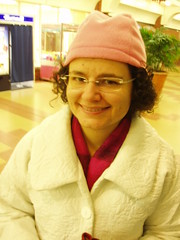
Although a week is always far too short, it was fantastic to have her here and I'm thankful that she made the trip at all - I'm grateful for all the time that we got to spend together. Kyle is a great documenter of her life, so for details of what we got up to (along with pictures!) I'd recommend checking out her blog (starting here). But mainly I'll remember just spending time together, having fun and just laughing so much together at the silliest things (LOLcats, anyone?).
So yes, I'm feeling a little sad here on my own right now without her. But when I think of the great time that we had together I feel better, and I know that I'll see her again soon. Love you Baby!
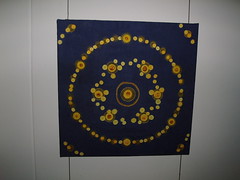
This time I had a bit longer and remembered to bring my camera, so one evening I decided I would get a few photos - I think that these are the kinds of things that Kyle would enjoy seeing and maybe she would enjoy the pictures. While I was busy snapping away a woman came and asked me why I was taking pictures - I was sure that I was going to get told off! But it turned out that she was Anne Griffith's - Diamond's "artist in residence" - and had been responsible for the collaboration of different artists that had produced the work.
She told me that she has a studio in office space next to the synchrotron ring, and that the panels - collectively called "Designs for Life" - were one of a number of different collaborations between artists and scientists at the lab. She also told me about how the panels had come to be produced, including one that featured stitching from many of the scientists - including the laboratory director. She also pointed out some other artworks in the atrium that I hadn't noticed before.
It was interesting to hear about the stories behind the art. To me they bring some warmth to the grand but possibly rather clinical atrium space, and also reveal the beauty in the science which is appreciated by scientists but sadly not always made visible to a lay audience - and in this (and in the source of their inspiration) they reminded me of similar designs for the 1951 Festival of Britain (celebrated in last year's "Atoms to Patterns" exhibition at the Wellcome Trust.
Anne has a website at http://www.pocketmouse.co.uk/ which talks about the "Designs for Life" project (amongst others) as part of her residency at Diamond - and you can see some of the panels in my (totally unofficial and completely unauthorise!) "Designs for Life" set on Flickr. Enjoy the collision of art, textiles and science!